Electrode Wire Selection Guide: Fix Frequent Wire Breakage, Slow Cutting Speed, and Rough Surface Finish
Publish Date: 19 Aug 2026
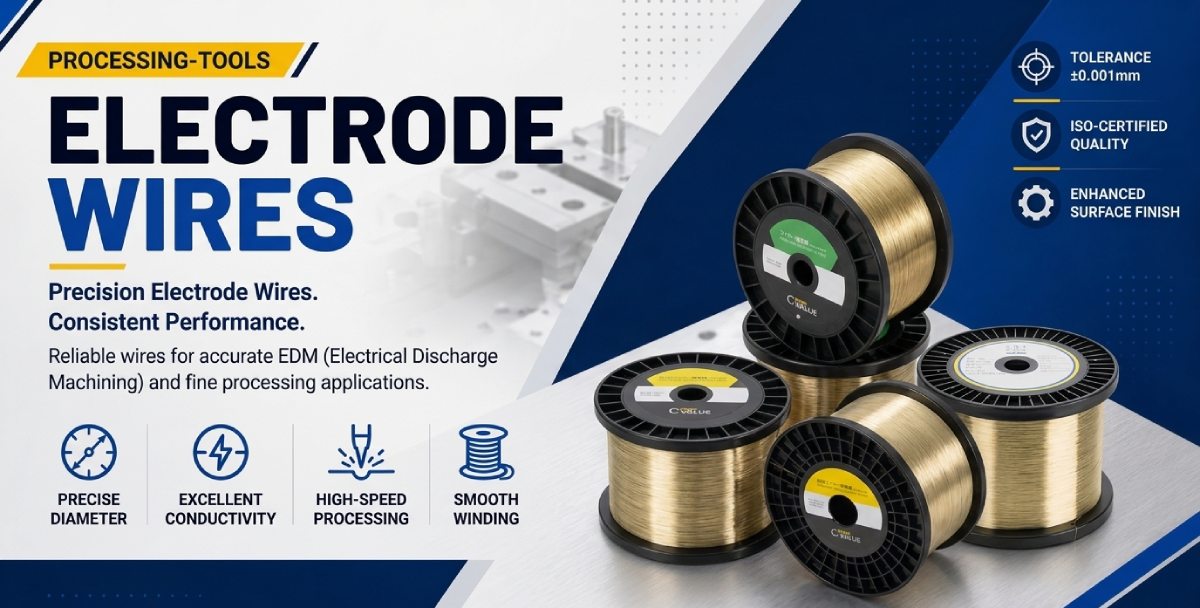
If your wire EDM machine keeps snapping mid-cut, forcing a re-thread and a restart every few hours, the machine's settings are usually not the real problem — the wire is. Frequent wire rupture, slow cutting speed, and inconsistent surface finish are among the most common operational complaints wire-cut EDM operators report, and in a large share of cases the root cause traces back to the electrode wire itself: the wrong grade, the wrong diameter, or wire that has sat on the shelf too long and developed winding curl.
Before adjusting generator parameters or servo settings, it's worth ruling out the wire first — it's the cheapest variable to fix and the easiest to get wrong.
What Electrode Wire Does — and Why It Fails
Electrode wire is the consumable conductor in wire-cut EDM. It never physically touches the workpiece; instead, a continuous stream of electrical discharges between the wire and the material melts and erodes a path through the workpiece as the wire feeds through. That's why EDM can cut hardened tool steel and carbide that conventional cutting tools struggle with.
That same mechanism is also the point of failure. Every discharge pulse generates heat directly in the wire. If heat builds faster than it's carried away, the wire weakens locally and breaks — usually near the top of the workpiece, where contact current is highest. Poor flushing, worn wire guides, misadjusted tension, and degraded power-feed contacts all compound this heat problem, which is why breakage is rarely caused by one single factor.

The Range Available: Electrode Wires on MISUMI India
MISUMI India's Electrode Wires category, under Electric Discharge Tools within Processing Tools, covers three main product lines that solve different parts of the wire-selection problem:
- Electrode Wire, Copper: Zinc = 60:40 Type (GMWC/GMWT series) — an economy-grade wire manufactured to the same speed and accuracy level as genuine brands, with tensile strength rated 950–1100 MPa. It's supplied in 0.2, 0.25, and 0.3 mm diameters, in 5 kg and 20 kg reel weights, and is aimed at shops prioritizing cost-per-cut without sacrificing consistency.
- Electrode Wire, Copper: Zinc = 65:35 Type (MBWC/MBWB series) — available with or without a paraffin coating (the "B" variants carry paraffin; the "C" variants don't), with tensile strength of 930–980 MPa depending on diameter. This line is built for strong wire-connection reliability on machines from brands like Mitsubishi Electric and Makino Milling, and is positioned to extend consumable life on those machines.
- Electrode Wire For High Speed Machining (BBHP series) — a high-speed wire with a thick zinc-diffusion layer, tensile strength ≥900 MPa, conductivity ≥20% IACS, and documented first-cut speed improvements of roughly 14–26% over regular brass wire across tested Sodick, Mitsubishi, and Agie Charmilles machines.
All three lines are wound on bobbins in 5, 10, or 20 kg formats, and MISUMI notes that finer diameters (0.2–0.3 mm) are matched to workpiece thickness and shape rather than chosen arbitrarily.
Matching Your Symptom to the Right Product
| Symptom on the Line | Likely Root Cause | Product to Select |
|---|---|---|
| Frequent wire rupture mid-cut on routine jobs | Wire tension or heat load exceeding standard-grade wire's tensile strength | GMWC/GMWT 60:40 wire — rated 950–1100 MPa tensile strength, suited to stable, repeat cutting |
| Wire breaks specifically near the top of thick workpieces | High current density at the point of maximum contact area | Confirm diameter (0.2–0.3 mm) matches workpiece thickness before switching wire grade |
| Cutting speed too slow for production targets | Wire material's conductivity not suited to the job's heat/discharge profile | BBHP high-speed wire — documented 14–26% faster first-cut times over standard brass |
| Poor automatic wire-threading / reconnection after a break | Wire straightness or connection reliability on the specific EDM brand in use | MBWC/MBWB 65:35 wire — built for strong connection ratios on Mitsubishi Electric and Makino Milling machines |
| Random disconnection or misfeed at the spool | Winding curl from wire left idle too long before use | Any line above — use freshly received bobbins promptly rather than holding stock |
| Erratic cutting despite a wire change | Worn wire guides or power-feed contacts (a machine-side issue, not a wire defect) | Rule out guide and contact wear separately before switching wire grade again |

Specifications Worth Comparing Before You Order
Three specifications drive most selection decisions across these three lines: tensile strength, diameter, and copper-zinc ratio. Higher tensile strength (as in the 60:40 GMWC/GMWT line) resists breakage under tension; a higher zinc content (as in the 65:35 MBWC/MBWB line) tends to support faster processing speed and better wire-connection reliability on specific machine brands. Diameter should always be matched to workpiece thickness — a wire too thin for a thick section increases breakage risk, while an oversized wire wastes cutting speed on thinner work. It's also worth checking whether your machine's instruction manual recommends a paraffin-coated wire (the MBWB variant) or a non-paraffin wire (MBWC), since this affects flushing behavior.
Buying and Procurement Considerations
Electrode wire is a high-turnover consumable, so procurement efficiency matters as much as the spec match. If your shop runs multiple wire-cut EDM machines, standardizing on one product line across machines that share a job profile reduces the number of SKUs your stores team tracks and reorders — and reduces the chance of an operator grabbing the wrong bobbin under time pressure, a common and avoidable cause of breakage. Reel sizes across all three lines run 5, 10, and 20 kg, so order quantity can be matched to your actual cutting volume rather than defaulting to the largest reel. Given the winding-curl risk on idle stock, plan orders around near-term consumption.

Common Selection Mistakes
The most frequent mistake is misdiagnosis: treating a wire problem as a machine problem, or the reverse. Operators sometimes spend weeks adjusting generator settings when the actual cause is degraded stock that sat too long in storage. The opposite mistake also happens — switching wire repeatedly without checking whether worn guides or power-feed contacts are the real source of erratic cutting. A second common mistake is picking a diameter by habit rather than by the current job's thickness. A third is choosing the economy-grade 60:40 wire for a job that actually needs the connection reliability of the 65:35 line, or vice versa — paying for speed the job doesn't need.
Maintenance, Replacement, and Lifecycle Planning
Electrode wire has no maintenance in the traditional sense — it's a single-use consumable, fed continuously and discarded after the cut. The lifecycle planning that matters is upstream: rotate stock so older bobbins are used first, and keep wire guides and power-feed contacts on a separate maintenance schedule so wire-related and machine-related wear don't get confused. Replacing wire on a fixed job-count or time interval, rather than only after a break occurs, reduces unplanned downtime in high-utilization shops.

Final Selection Checklist
- Match diameter (0.2, 0.25, or 0.3 mm) to workpiece thickness and cut geometry
- Choose the 60:40 GMWC/GMWT line for standard-duty, cost-driven cutting
- Choose the 65:35 MBWC/MBWB line for stronger wire-connection reliability on Mitsubishi Electric or Makino Milling machines
- Choose the BBHP high-speed line where production throughput is the priority
- Confirm paraffin vs. non-paraffin per your machine's instruction manual
- Check bobbin age and storage time before mounting — avoid using wire that's sat idle too long
- Separate wire-side symptoms from guide/contact wear before switching products again
- Order reel size (5/10/20 kg) matched to near-term use, not long-term stockpiling
Getting the electrode wire spec right — grade, diameter, and freshness — resolves most breakage, speed, and finish complaints before a machine parameter ever needs touching. Compare the 60:40 economy wire, 65:35 wire, and high-speed BBHP wire directly on the Electrode Wires category page to place an order.

Frequently Asked Questions (FAQs)
1. What's the difference between 60:40 and 65:35 copper-zinc electrode wire?
The ratio refers to the copper-to-zinc content in the brass alloy. The 60:40 type (GMWC/GMWT) is an economy-grade wire built for stable, repeat cutting at a lower cost. The 65:35 type (MBWC/MBWB) carries a higher zinc content, which supports stronger automatic wire-connection performance and is positioned for use on machines from brands like Mitsubishi Electric and Makino Milling. Neither ratio is universally "better" — the right choice depends on your machine brand and whether cost or connection reliability matters more for your job.
2. Which electrode wire gives the best value for cost-sensitive, high-volume cutting?
For shops running frequent, standard-duty cuts where cost-per-reel matters most, the Electrode Wire, Copper:Zinc = 60:40 Type (GMWC/GMWT) is the economy option — manufactured to match the speed and accuracy of genuine-brand wire at a lower price point. If throughput is the bigger cost driver, the BBHP high-speed wire can offset its higher unit cost through documented cutting-time reductions, so the better "value" wire depends on whether you're optimizing for material cost or machine time.
3. How do I order electrode wire online from MISUMI India?
You can browse and configure electrode wire directly on the Electrode Wires category page, select your required diameter, reel weight, and paraffin option on the relevant product page — such as 60:40 type, 65:35 type, or BBHP high-speed wire — and place the order online with no minimum order quantity.
4. Can a broken electrode wire segment be reused, or does it need replacing entirely?
Electrode wire is a single-use consumable — once it breaks or is spent during a cut, the affected section can't be reintroduced into the machine at the same reliability level. The recommended approach is to re-thread from a fresh point on the reel and treat the break as a signal to check wire freshness, tension, and guide condition, rather than to attempt reuse of the broken segment.
5. Is high-speed electrode wire compatible with all wire-cut EDM machine brands?
The BBHP high-speed electrode wire is documented as a general-purpose product tested across Sodick, Mitsubishi, and Agie Charmilles machines, with recorded cutting-speed improvements on each. That said, machine-specific generator settings may need fine-tuning when switching wire types, so it's worth checking your EDM's instruction manual before changing from standard brass wire to a high-speed variant.


