Support Unit Selection Guide: Stop Getting Ball Screw Positioning Wrong
Publish Date: 29 June 2026
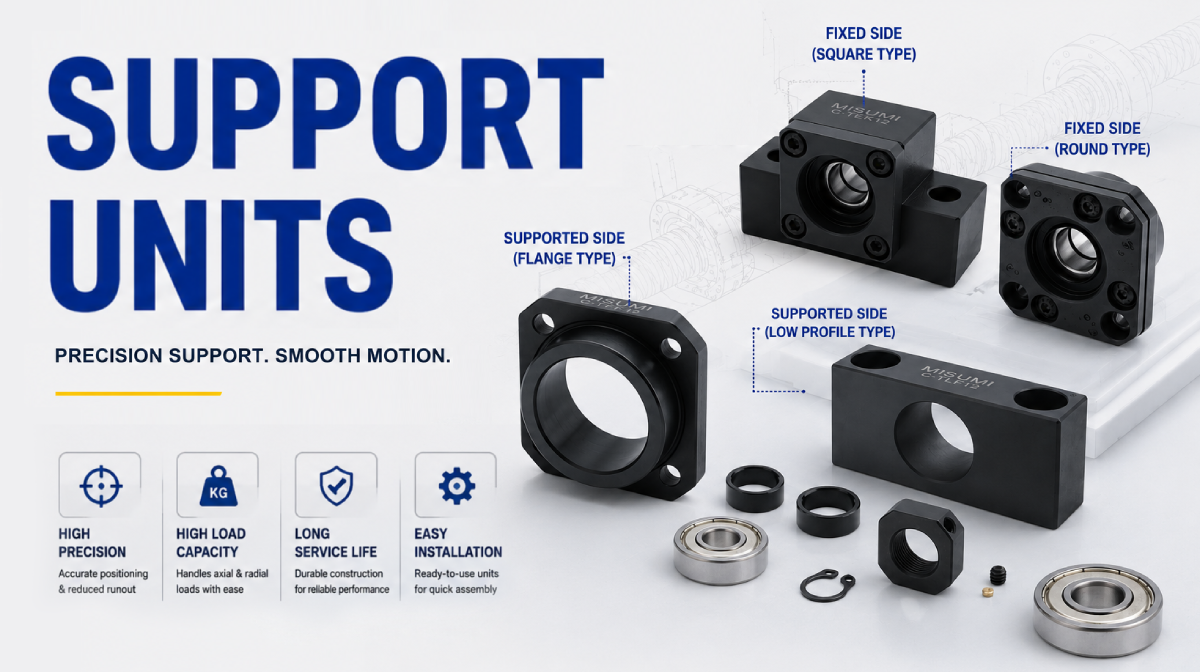
In any ball screw-driven linear motion system, the performance and longevity of the entire mechanism depend heavily on one often-overlooked component: the Support Unit. Whether you are designing a CNC machining centre, a robotic actuator, or an automated assembly line, the way the ball screw shaft is mounted and constrained at its ends directly determines positional accuracy, load capacity, and operational life.
Support Units are specially designed bearing assemblies that support the ends of a ball screw, ensuring stable rotation while handling axial and radial loads. By maintaining proper alignment and reducing unwanted movement, they help maximize the performance, accuracy, and service life of ball screw systems.
This guide covers everything engineers and technical buyers need to know: how Support Units work, the different types available, what to look for when selecting one, and how MISUMI's economy series products deliver reliable performance at competitive value.
What Are Support Units?
A Support Unit is a pre-assembled bearing housing component designed specifically to mount and constrain a ball screw shaft at one or both ends. Unlike standard bearing housings used in rotary applications, Support Units are engineered around the unique demands of linear motion — most importantly, the need to handle significant axial (thrust) loads generated when the ball screw converts rotary motion into linear movement.
General Construction
A typical Support Unit is supplied as a fully assembled unit and consists of:
- Housing (machined steel, black oxide coated for corrosion protection)
- Angular contact bearing (especially in fixed-side units, to handle axial loads)
- Bearing cover and oil seals (front and rear, for contamination protection)
- Collar accessories (front and rear, for proper shaft positioning)
- Bearing nut with set piece (to lock the bearing assembly in place)
Important Assembly Note: Fixed-side Support Units must never be disassembled in the field. The bearing preload is factory-set and calibrated during manufacturing. Disassembly destroys the preload setting, compromising both stiffness and accuracy.

Types of Support Units: Fixed Side vs. Supported Side
Support Units come in two fundamental types, each serving a distinct function within the ball screw assembly. Understanding the difference is essential before selecting any component.
1. Fixed Side Support Units
The Fixed Side Support Unit is installed at the driven end of the ball screw — typically the motor end. Its primary functions are:
- Axially locating the ball screw shaft (preventing it from moving forward or backward)
- Absorbing thrust loads generated during linear motion in both directions
- Providing rigid rotational support to minimize deflection under load
Fixed side units use angular contact bearings, which are specifically designed to handle combined axial and radial loads. In many designs, bearings are arranged in a back-to-back (DB) or face-to-face (DF) configuration to handle bidirectional thrust.
Key Technical Characteristics
| Parameter | Details |
|---|---|
| Bearing type | Angular contact bearing (preloaded) |
| Load capacity | High axial load (both directions) + radial load |
| Shaft diameters | φ8, φ10, φ12, φ15 (economy series) |
| Material | Steel |
| Surface treatment | Black oxide coating |
| Disassembly | NOT permitted — preload is factory-set |

2. Supported Side Support Units
The Supported Side Support Unit is installed at the opposite (non-driven) end of the ball screw shaft. Its role is fundamentally different from the fixed side:
- It supports the shaft radially, preventing deflection and vibration at the free end
- It deliberately allows axial movement of the shaft — accommodating thermal expansion and assembly tolerance
- It stabilises rotation without imposing additional constraints on the axial position
Because supported-side units are not required to handle thrust loads, they typically use deep groove ball bearings or simple plain bearings. The internal design allows the shaft to float axially within the unit.
Key Technical Characteristics
| Parameter | Details |
|---|---|
| Bearing type | Deep groove or floating bearing |
| Load capacity | Radial load only; axial float permitted |
| Shaft diameters | φ6, φ10, φ12, φ15 (economy series) |
| Material | Steel |
| Surface treatment | Black oxide coating |
| Disassembly | Permitted for maintenance where applicable |

How to Select the Right Support Unit: Key Engineering Considerations
Selecting a Support Unit incorrectly is one of the most common causes of premature ball screw failure and positioning inaccuracy. The following factors should guide your selection:
1. Shaft Diameter Compatibility
The Support Unit bore must exactly match the ball screw shaft diameter. MISUMI economy series units cover the most common sizes: φ8, φ10, φ12, and φ15 mm. Always verify the shaft diameter specified in your ball screw datasheet before ordering.
2. Fixed Side vs. Supported Side
Every ball screw assembly requires one fixed side and one supported side unit. Never install two fixed-side units on the same screw — this over-constrains the shaft, creating thermal stress and premature bearing failure. The fixed side goes at the driven (motor) end; the supported side goes at the free end.

3. Axial Load Rating
Calculate the maximum thrust load your application generates during acceleration, deceleration, and cutting or process forces. The fixed side Support Unit must have an axial dynamic load rating that exceeds this value with appropriate safety margin (typically 1.5x to 2x the maximum calculated load).
4. Speed (DN Value)
Support Units have a maximum allowable speed, expressed as the DN value (bearing bore diameter in mm × rotational speed in rpm). Verify that your application's maximum ball screw speed does not exceed the unit's rated DN limit.
5. Mounting Interface
MISUMI economy series units include both flange-mount variants (e.g., C TFK12, C TFF15) and standard end-mount variants (e.g., C TEK12, C TEF12). Select the mounting style that suits your machine structure. Flange mounts offer easier alignment during installation; end mounts are more compact.
6. Environmental Conditions
All MISUMI economy series Support Units feature black oxide coating for corrosion resistance and include oil seals to prevent contamination ingress. For high-contamination environments (coolant, chips, dust), consider units with enhanced sealing or apply supplementary protective measures.
7. Preload and Stiffness
For high-precision applications, confirm the preload specification of the fixed side unit. MISUMI's assembled economy series units ship with factory-set preload — do not disassemble or attempt to re-preload them in the field.

Frequently Asked Questions
Can I use two fixed-side Support Units on one ball screw?
No. Two fixed-side units over-constrain the shaft. Thermal expansion of the screw during operation has no relief path, which generates enormous preload forces that rapidly destroy both bearings. Always use one fixed side and one supported side unit.
Can fixed side Support Units be disassembled for bearing replacement?
MISUMI's pre-assembled fixed side economy series units must not be disassembled. The bearing preload is set at the factory to precise specifications. Disassembly permanently loses this setting. Replace the complete unit rather than attempting to service individual components.
What shaft tolerances are required for Support Unit installation?
Ball screw shaft ends are typically ground to k5 or j5 tolerance for fixed-side fits, and g6 for supported-side fits, to maintain the interference or clearance fit required by each bearing type. Always refer to the specific MISUMI product datasheet for dimensional requirements.
Are MISUMI economy series Support Units suitable for high-speed applications?
The economy series is designed for general-purpose industrial automation. For very high-speed ball screw applications (above 2000 rpm in larger diameter sizes), review the DN value specification in the individual product datasheet and consider MISUMI's standard or high-precision series if required.
Explore MISUMI Support Units
Looking for reliable Support Units for your next automation project? MISUMI offers a comprehensive range of Support Units and Economy Series models designed for precision ball screw applications across industries.
Explore the complete product range here:
Click Here
With a wide selection of standard and Economy Series Support Units, MISUMI helps engineers and machine builders simplify design, improve accuracy, and keep industrial automation systems operating efficiently.



