Linear Motion Components in the Automation Industry: Detailed Insights
Publish Date: 6 Oct 2025
The automation industry relies heavily on precise, reliable linear motion systems to achieve efficient, repeatable movements in manufacturing, assembly, and processing equipment. Linear motion components form the backbone of these systems by enabling smooth, controlled, and accurate travel along predetermined paths. Below is a detailed exploration of key linear motion components, their functions, and important application considerations.
Linear Shafts
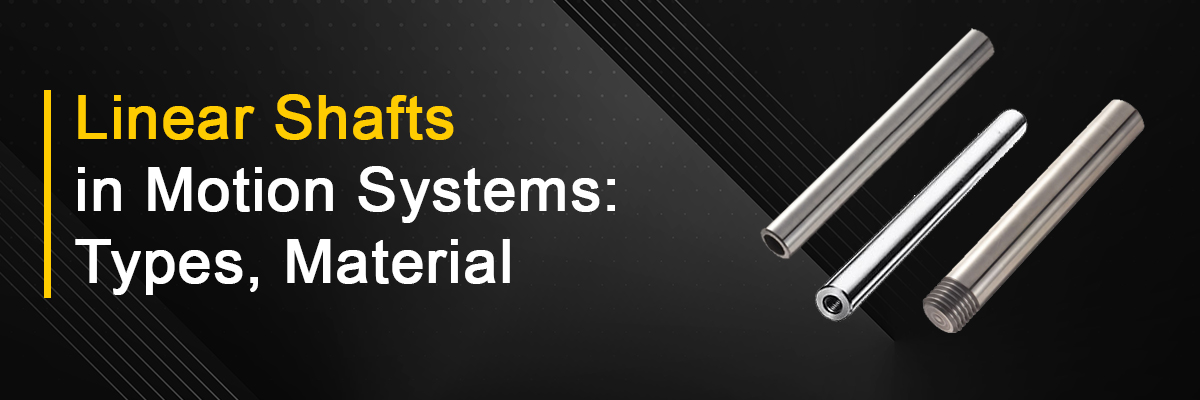
Linear shafts are cylindrical rods, typically made from hardened steel or stainless steel, that serve as rails for linear motion systems. Their high rigidity and precision ground surfaces ensure minimal deflection and smooth sliding motion.
- Applications: Used in linear bearings, bushings, and guides to support load and maintain alignment in automation machinery such as CNC routers, 3D printers, and robotic arms.
- Key Features: Surface hardness (often induction hardened), diameter tolerance to fit bearings, corrosion resistance options for harsh environments.
Shaft Supports
Shaft supports secure linear shafts firmly, ensuring the shaft remains straight and vibration-free during operation. They come in various mounting styles, such as flange or base type, providing stable anchoring points.
- Applications:Critical for shafts traveling over extended lengths in machines like conveyors and linear actuators, preventing bending and extending shaft life.
Shaft Collars
Shaft collars are clamping or set-screw style rings fitted around shafts to act as mechanical stops, guides, or spacers. They are essential in positioning components like bearings, pulleys, and gears along shafts.
- Applications: Used to limit travel range in linear actuators and maintain components in fixed positions within automated assemblies.
- Material Options:Steel, stainless steel, or plastic for different environmental and load conditions.
Linear Bushings
Linear bushings, or linear bearings, are sliding elements designed to move along linear shafts with minimal friction. They typically include ball or roller elements recirculating inside the bushing to facilitate smooth movement.
- Applications: Widely used in precision equipment such as lab automation, packaging machinery, and printing presses where smooth linear travel is crucial.
- Lubrication: Available in lubricated or maintenance-free (oil-free) variants, depending on operating environment.
Ball Guides
Ball guides, also called linear ball guides, provide highly accurate and smooth linear motion using rows of recirculating balls within hardened steel rails and blocks.
- Applications:Perfect for heavy-load, high-speed machining centers, semiconductor fabrication equipment, and robotic axes requiring micron-level accuracy.
- Advantages:High rigidity, excellent load capacity, and low wear resistance.
Spline Shafts
Spline shafts are designed with longitudinal grooves or teeth that allow torque transfer while enabling axial movement. They combine rotary and linear motion on the same axis.
- Applications: Used in complex automation systems like multi-axis robots and transfer devices, where coordinated rotational and linear motion is needed.
Oil-Free Bushings and Washers
These components use self-lubricating polymer materials or impregnated graphite to eliminate the need for external lubrication.
- Applications: Ideal for cleanroom automation, food processing, and medical industries where lubricant contamination must be avoided.
- Benefits: Maintenance-free operation, silent running, and resistance to dust and dirt ingress.
Linear Motor Actuators
Linear motor actuators provide direct, frictionless linear motion using electromagnetic forces without mechanical conversion mechanisms like screws or belts.
- Applications: Semiconductor wafer handling, high-speed packaging, precision inspection equipment.
- Benefits: Extremely high acceleration, positional accuracy, and minimal wear compared to traditional mechanical systems.
Oil-Free Plates and Guide Rails
These elements feature sliding contact surfaces incorporating low-friction, oil-free materials or coatings to reduce maintenance and operational noise.
- Applications: Widely applied in precision tooling, molds, and compact linear motion assemblies requiring consistent performance without lubrication.
Linear Guides
Linear guides consist of hardened steel rails with rolling elements contained inside sliders to provide robust, precise, and smooth linear motion.
- Applications: Critical components in CNC machines, assembly robots, and large automated plants requiring heavy load capacity and long stroke lengths.
- Variations: Types include square rail guides, round shaft guides, and profile rail guides tailored to specific applications.
Cable Carriers
Cable carriers (energy chains) manage and protect cables and hoses that move repeatedly along with machinery parts, preventing tangling or damage.
- Applications: Used in articulated robots, CNC machines, and automated conveyor systems to ensure reliable power and signal transmission.
Ball Screws
Ball screws convert rotary motion into linear movement using rolling ball bearings between the screw shaft and nut, greatly reducing friction.
- Applications: Precision positioning in CNC machining, robotic actuators, and stage drives for optical and inspection equipment.
- Advantages: High efficiency, low backlash, and long service life.
Support Units
Support units provide rigid mounting and precise alignment for ball screws or lead screws at their ends. They typically comprise bearing housings and flange assemblies.
- Applications: Support screw shafts in machine tools and automated stages, reducing vibration and increasing motion accuracy.
Lead Screws and Slide Screws
Lead screws use a threaded shaft and nut to create linear movement, often preferred for quieter operation and load holding without back-driving.
- Applications: Suitable for light-to-medium load positioning in lab instruments, inspection equipment, and pick-and-place modules.
Cross Roller Guides
Cross roller guides use cylindrical rollers arranged alternately at 90 degrees for increased rigidity and precise linear motion with minimal twisting.
- Applications: Optical inspection systems, precision measuring devices, and semiconductor manufacturing requiring ultra-fine accuracy.
Slide Packs, V Guides, Linear Rails
These compact, modular guiding systems combine V-shaped guide bearings or slide pads with linear rails for stable, space-efficient linear motion.
- Applications: Suitable for packaging machinery, robotic arms with limited envelope, and automated assembly lines.
Actuators / Single Axis Robots
Integrated linear actuators or single-axis robots consist of a motor, guide, and transmission mechanism providing programmed linear displacement.
- Applications: Automated pick and place, dispensing, material handling, and packaging automation.
- Features: Compact design, built-in control options, and customizable stroke lengths.
Bellows
Bellows protect critical motion components like ball screws, guides, and shafts from dust, chips, and coolant fluids during metalworking or machining operations.
- Applications: Utilized in machine tools, laser cutting machines, and industrial robots to prolong system life and maintain precision.
Conclusion
In the automation industry, selecting the right linear motion components is vital for achieving consistent performance, precision, and durability. From basic shafts and bushings to advanced linear motor actuators and cross roller guides, each component contributes to the smooth, reliable operation of automated systems. Understanding these components' functionalities and applications helps engineers and designers build more efficient and high-performing automation machinery.


