Indexing Plungers Threaded Tip

Brand :
MISUMI
Caution
Product Description
New at MISUMI? Get upto ₹10,000 Discount* on Your First Order. Click to Register Now

Product Overview
Indexing Plungers Threaded Tip
♢Indexing plunger, also called indexing pin, is a locating pin that can be inserted and extracted manually. Suitable for fixture indexing, positioning, stop limit and other occasions.
It is generally divided into two types: reset and self-locking type.
♢Indexing plunger, also called indexing pin, is a locating pin that can be inserted and extracted manually. Suitable for fixture indexing, positioning, stop limit and other occasions.
It is generally divided into two types: reset and self-locking type.
Dimensional Drawing

Specification Table
Indexing Plungers Threaded Tip
Material Specification
| Part Number | Thread Pitch (Fine) | S (stroke) | B | D | D1 | M1 (Coarse) | e | L | L1 | L2 | L3 | L4 | SW1 | SW2 | Load (N) | |||
| Type | M | |||||||||||||||||
| Reset Type | Self-Locking Type | min. | max. | |||||||||||||||
(Reset type) (Self-locking type) E-LPXTAB E-LPXTYB E-LPXTNB E-LPXTYB E-LPXTAS E-LPXTYS E-LPXTNS E-LPXTSS | 10 | 1.0 | 5 | 5 | 18 | 13.8 | M3 | 5 | 45 | 50 | 17 | 5 | 15 | 5 | 12 | 16 | 3.9 | 13.5 |
| 8 | 48 | 53 | ||||||||||||||||
| 12 | 1.5 | 6 | 6 | 21 | 16.2 | M4 | 6 | 54.5 | 60.5 | 20 | 6 | 17 | 6 | 14 | 19 | 6.4 | 18 | |
| 10 | 58.5 | 64.5 | ||||||||||||||||
| 16 | 1.5 | 7 | 8 | 26 | 21.9 | M5 | 8 | 68 | 75.5 | 26 | 8 | 23 | 8 | 19 | 24 | 11.3 | 23 | |
| 12 | 73 | 80.5 | ||||||||||||||||
Material Specification
| Thread | Type | Knob | Body | Pin | Spring | Nut | |||||
| Reset Type | Self-Locking Type |  Material Material | Material |  Surface Treatment Surface Treatment | Material | Surface Treatment |  Hardness Hardness | Material | Material | Surface Treatment | |
| Fine Thread | E-LPXTAB | E-LPXTYB | A6061 (Black Anodized) | 1215 | Black Oxide | S45C | Black Oxide | 45~55HRC | SUS304 | - | - |
| E-LPXTNB | E-LPXTSB | S35C | Black Oxide | ||||||||
| E-LPXTAS | E-LPXTYS | SUS303 | - | SUS420F | Nickel Plating | 40~50HRC | - | - | |||
| E-LPXTNS | E-LPXTSS | SUS304 | - | ||||||||
Product Features
♢This series allows accessories to be mounted at the tip.
♢ The plunger has a simple structure: the tip is pushed out through a fixed stroke by the internal spring and it can be released by pressing in the ball or the pin against the elastic force.
♢ The plunger has a simple structure: the tip is pushed out through a fixed stroke by the internal spring and it can be released by pressing in the ball or the pin against the elastic force.
Usage Method
Usage Method
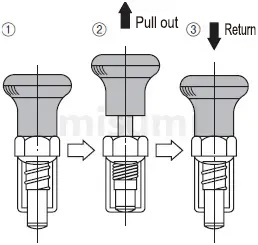
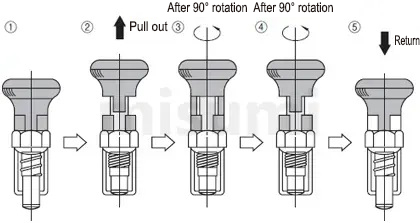
How to operate the reset type and self-locking type
•Reset type
1. The front end is usually protruding.
2. The front end retracts when the knob is pulled out.
3. If the knob is released, the front end will return to the protruding state through the action of the built-in spring force.
•Reset type
1. The front end is usually protruding.
2. The front end retracts when the knob is pulled out.
3. If the knob is released, the front end will return to the protruding state through the action of the built-in spring force.
•Self-locking type
1. The front end is usually protruding.
2. The front end retracts when the knob is pulled out.
3. If the front end is rotated by 90° while maintaining the pull-out state, the retraction state of the front end can be locked.
4. To release the locked state, simply rotate 90° while maintaining the pulled-out state.
5. If the knob is released, the front end will return to the protruding state through the action of the built-in spring force.
1. The front end is usually protruding.
2. The front end retracts when the knob is pulled out.
3. If the front end is rotated by 90° while maintaining the pull-out state, the retraction state of the front end can be locked.
4. To release the locked state, simply rotate 90° while maintaining the pulled-out state.
5. If the knob is released, the front end will return to the protruding state through the action of the built-in spring force.
